Author Archives: 瀬分

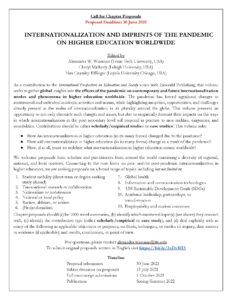
Call for Chapter Proposals – Proposal Deadline: 30 June 2021

【情報提供者:一橋大学 太田浩氏】

詳細は画像をクリックしてください

この度、米国Lehigh UniversityのVice President Dr. Cheryl Matherly氏より、以下の書籍出版予定のご案内をいただきました。

「世界の高等教育における国際化とパンデミックの影響」に関する多様な地域からの考察をまとめた書籍にしたいとのことで、以下の通り執筆者を公募しますとのことです。

【予定されている書籍タイトル】INTERNATIONALIZATION AND IMPRINTS OF THE PANDEMIC ON HIGHER EDUCATION WORLDWIDE
※International Perspectives on Education and Societyシリーズとして出版予定
https://www.emerald.com/insight/publication/issn/1479-3679

【スケジュール】
章の提案提出締切:2021年6月30日
採否決定:2021年7月15日
原稿提出締切:2021年10月1日
出版予定:2022年春/夏

詳細をお問い合わせになりたい場合は、以下の案内文にあります問い合わせ先メールアドレスへ直接ご連絡ください。

ーーーーーーーーーーー
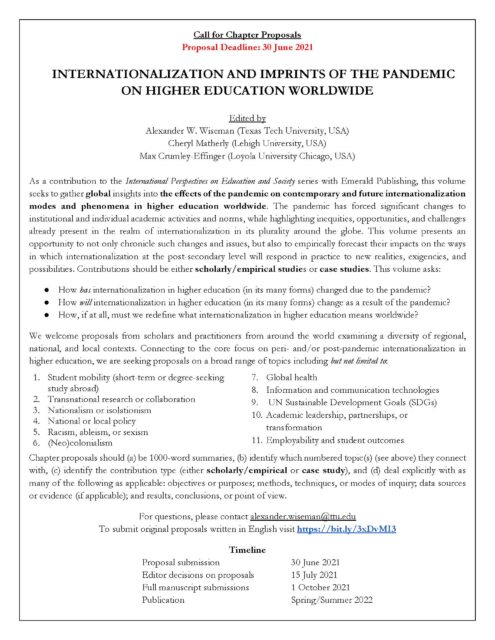
Call for Chapter Proposals
Proposal Deadline: 30 June 2021

INTERNATIONALIZATION AND IMPRINTS OF THE PANDEMIC ON HIGHER EDUCATION WORLDWIDE

Edited by
Alexander W. Wiseman (Texas Tech University, USA)
Cheryl Matherly (Lehigh University, USA)
Max Crumley-Effinger (Loyola University Chicago, USA)

As a contribution to the International Perspectives on Education and Society series with Emerald Publishing, this volume seeks to gather global insights into the effects of the pandemic on contemporary and future internationalization modes and phenomena in higher education worldwide. The pandemic has forced significant changes to institutional and individual academic activities and norms, while highlighting inequities, opportunities, and challenges already present in the realm of internationalization in its plurality around the globe. This volume presents an opportunity to not only chronicle such changes and issues, but also to empirically forecast their impacts on the ways in which internationalization at the post-secondary level will respond in practice to new realities, exigencies, and possibilities. Contributions should be either scholarly/empirical studies or case studies. This volume asks:

How has internationalization in higher education (in its many forms) changed due to the pandemic?
How will internationalization in higher education (in its many forms) change as a result of the pandemic?
How, if at all, must we redefine what internationalization in higher education means worldwide?

We welcome proposals from scholars and practitioners from around the world examining a diversity of regional, national, and local contexts. Connecting to the core focus on peri- and/or post-pandemic internationalization in higher education, we are seeking proposals on a broad range of topics including but not limited to:
1. Student mobility (short-term or degree-seeking study abroad)
2. Transnational research or collaboration
3. Nationalism or isolationism
4. National or local policy
5. Racism, ableism, or sexism
6. (Neo)colonialism
7. Global health
8. Information and communication technologies
9. UN Sustainable Development Goals (SDGs)
10. Academic leadership, partnerships, or transformation
11. Employability and student outcomes

Chapter proposals should (a) be 1000-word summaries, (b) identify which numbered topic(s) (see above) they connect with, (c) identify the contribution type (either scholarly/empirical or case study), and (d) deal explicitly with as many of the following as applicable: objectives or purposes; methods, techniques, or modes of inquiry; data sources or evidence (if applicable); and results, conclusions, or point of view.

For questions, please contact  alexander.wiseman@ttu.edu

To submit original proposals written in English visit https://luc.co1.qualtrics.com/jfe/form/SV_5dbdhFVTBVuoEzI

Timeline
Proposal submission: 30 June 2021
Editor decisions on proposals: 15 July 2021
Full manuscript submissions: 1 October 2021
Publication: Spring/Summer 2022

記事のお問い合わせ先: For questions, please contact  alexander.wiseman@ttu.edu
Call for Chapter Proposals – Proposal Deadline: 30 June 2021

Click to enlarge

Call for Chapter Proposals
Proposal Deadline: 30 June 2021

INTERNATIONALIZATION AND IMPRINTS OF THE PANDEMIC ON HIGHER EDUCATION WORLDWIDE

Edited by
Alexander W. Wiseman (Texas Tech University, USA)
Cheryl Matherly (Lehigh University, USA)
Max Crumley-Effinger (Loyola University Chicago, USA)

As a contribution to the International Perspectives on Education and Society series with Emerald Publishing, this volume seeks to gather global insights into the effects of the pandemic on contemporary and future internationalization modes and phenomena in higher education worldwide. The pandemic has forced significant changes to institutional and individual academic activities and norms, while highlighting inequities, opportunities, and challenges already present in the realm of internationalization in its plurality around the globe. This volume presents an opportunity to not only chronicle such changes and issues, but also to empirically forecast their impacts on the ways in which internationalization at the post-secondary level will respond in practice to new realities, exigencies, and possibilities. Contributions should be either scholarly/empirical studies or case studies. This volume asks:

How has internationalization in higher education (in its many forms) changed due to the pandemic?
How will internationalization in higher education (in its many forms) change as a result of the pandemic?
How, if at all, must we redefine what internationalization in higher education means worldwide?

We welcome proposals from scholars and practitioners from around the world examining a diversity of regional, national, and local contexts. Connecting to the core focus on peri- and/or post-pandemic internationalization in higher education, we are seeking proposals on a broad range of topics including but not limited to:
1. Student mobility (short-term or degree-seeking study abroad)
2. Transnational research or collaboration
3. Nationalism or isolationism
4. National or local policy
5. Racism, ableism, or sexism
6. (Neo)colonialism
7. Global health
8. Information and communication technologies
9. UN Sustainable Development Goals (SDGs)
10. Academic leadership, partnerships, or transformation
11. Employability and student outcomes

Chapter proposals should (a) be 1000-word summaries, (b) identify which numbered topic(s) (see above) they connect with, (c) identify the contribution type (either scholarly/empirical or case study), and (d) deal explicitly with as many of the following as applicable: objectives or purposes; methods, techniques, or modes of inquiry; data sources or evidence (if applicable); and results, conclusions, or point of view.

For questions, please contact alexander.wiseman@ttu.edu
To submit original proposals written in English visit https://luc.co1.qualtrics.com/jfe/form/SV_5dbdhFVTBVuoEzI

Timeline
Proposal submission: 30 June 2021
Editor decisions on proposals: 15 July 2021
Full manuscript submissions: 1 October 2021
Publication: Spring/Summer 2022

For questions, please contact alexander.wiseman@ttu.edu
2021年4月~5月登録記事一覧

(2021年4月13日付)「研究者は、ワクチンナショナリズムの台頭にどのように対処できるか」
【University World News】How academics can address rise of vaccine nationalism
・「ワクチンのナショナリズムは戦略である。」
・「経済的に不利なプレーヤーに先んじて、特定の種類の資源、新しく開発されたワクチンの獲得をもたらす方法を通じて行動する。」

(2021年4月7日付)「パンデミックとしての危機に瀕している私立大学は、入学に打撃を受けている」
【University World News】Private universities in crisis as pandemic hits enrolmen
・ドロップアウト数が増加。
・私立大学では、閉鎖等が起こっている。

(2021年4月9日付)「外国人留学生の入学者数は、予想よりも21万人少ない」
【University World News】Foreign student enrolments 210,000 lower than expected
・「オーストラリアの大学は、今年、予想よりも21万人少ない外国人留学生が登録している。」
・「手数料収入は18億豪ドル(14億米ドル)減少している。」

(2021年4月15日付)「COVID-19のワクチン接種を奨励するため、一部のキャンパスではインセンティブが追加」
【The Chronicle of Higher education】To Encourage Covid-19 Vaccination, Some Campuses Add Incentives

(2021年4月22日付)「ワクチンに反対のグループが、ラトガーズ大学のCOVID-19のワクチン接種の要件に異議を唱える」
【The Chronicle of Higher education】Anti-Vaccine Group Challenges Rutgers U.’s Covid-19 Vaccination Requirement

(2021年5月5日付)「学生、または、雇用者にCOVID-19の予防接種を義務付ける大学のリストは次のとおり」
【The Chronicle of Higher education】Here’s a List of Colleges That Will Require Students or Employees to Be Vaccinated Against Covid-19
(参考)
・「ワクチンのジレンマ」(2021年4月19日)
The Vaccination Dilemma Should colleges mandate Covid-19 shots? Encourage? Incentivize? All of the above?
・「キャンパスの再開」(159ドル)
『Reopening Campus』

(2021年4月2日付)「コーネル大学は、秋学期に学生にワクチン接種を義務付けることを計画」
【The Chronicle of Higher education】Cornell Plans to Require Students to Be Vaccinated for Fall Semester

(2021年5月5日付)「オハイオのコミュニティカレッジは、2021-22年スポーツを中止」
【INISIDE HIGHER ED】Ohio Community Colleges Cancel 2021-22 Sports

(2021年)「特別レポート」
【INISIDE HIGHER ED】Special Reports
(参考)
「Bridging the Digital Divide: Lessons from COVID-19」(2021年5月6日9時40分時点、無料でダウンロード可)

(2021年4月27日付)「学生は、パンデミック後のオンライン学習オプションを望んでいる」
【INISIDE HIGHER ED】Students Want Online Learning Options Post-Pandemic
(参考)
「Digital Learning Pulse Survey Results」

(2021年5月6日 蝶慎一)

(2021年4月13日付)「研究者は、ワクチンナショナリズムの台頭にどのように対処できるか」
【University World News】How academics can address rise of vaccine nationalism
・「ワクチンのナショナリズムは戦略である。」
・「経済的に不利なプレーヤーに先んじて、特定の種類の資源、新しく開発されたワクチンの獲得をもたらす方法を通じて行動する。」

(2021年4月7日付)「パンデミックとしての危機に瀕している私立大学は、入学に打撃を受けている」
【University World News】Private universities in crisis as pandemic hits enrolment
・ドロップアウト数が増加。
・私立大学では、閉鎖等が起こっている。

(2021年4月9日付)「外国人留学生の入学者数は、予想よりも21万人少ない」
【University World News】Foreign student enrolments 210,000 lower than expected
・「オーストラリアの大学は、今年、予想よりも21万人少ない外国人留学生が登録している。」
・「手数料収入は18億豪ドル(14億米ドル)減少している。」

(2021年4月15日 蝶慎一)

(2021年3月31日付)「キャンパス空間を再考すること」
【The Chronicle of Higher Education】Rethinking Campus Spaces
「・キャンパスはどのように自分のスペースをより思慮深く使用することを計画していますか?」
「・キャンパスでのオンライン作業と学習ドライブはどのように変化しますか?」
「・キャンパスの設計は、将来の学生の定着率を高めるのにどのように役立ちますか?」

(2021年3月26日付)「キャンパスがCovidを研究するためのラボになるとき」
【The Chronicle of Higher Education】When the Campus Becomes a Lab to Study Covid

(2021年3月25日付)「ラトガース大学は、秋学期に通学するためにCovid-19ワクチン接種の証明を必要とします」
【The Chronicle of Higher Education】Rutgers Will Require Proof of Covid-19 Vaccination to Attend in the Fall

(2021年3月6日付)「Covid-19のより感染性の高い変異株が、ウェスタンミシガン大学のキャンパスに蔓延していると推定」
【The Chronicle of Higher Education】More Infectious Variant of Covid-19 Assumed to Be Widespread on Western Michigan U. Campus

(2021年3月1日付)「さらに3つの大学が、秋学期における対面授業を宣言する」
【The Chronicle of Higher Education】3 More Universities Vow In-Person Fall Semesters
・アラバマ大学システム、オハイオ大学、テンプル大学のキャンパスでは、秋学期に対面授業を行うと宣言する

(2021年3月27日付)「大学のキャンパスは、パンデミック後にどのように変化するか?」
【University World News】How will university campuses change post-pandemic?
・具体的なポイントとして、「創造的な衝突とイノベーション(Creative collisions and innovation)」、「キャンパスからニューラルネットワークへ(From campus to neural network)」、「ミックスした使用環境(A mixed-use environment)」を挙げている。

(2021年3月23日付)「エジプトがCOVID-19ワクチンの臨床試験を開始」
【University World News】Egypt to start clinical trials on COVID-19 vaccine

(2021年3月27日付)「大学は、COVID-19において、学生を安全に守っているか」
【University World News】Are universities keeping students safe during COVID?
・ナイジェリアの170の大学の200万人近くの学生が、2021年1月18日までにキャンパスに戻るよう連邦政府から通知を受け始めた。
・しかし、当面の課題は高等教育機関が、人員と施設の観点から、急増する学生人口のCOVID-19予防ニーズを満たす能力を持っているかどうかである。
(参考)COVID-19: Nigerian universities pledged to keep students safe. Have they?

(2021年3月10日付)「パンデミックの影響により学生の中退率が上昇」
【University World News】Student dropout rate on the rise due to pandemic impact
・「4月に始まる新しい学年で、日本の大学は、家族の経済状況と学生の精神的健康に対するパンデミックに関わる新規および継続的な学生登録の減少を報告している」
・「河合塾が2月に行った調査によると、通常4月に行われる主要な私立大学の入学は、昨年に比べて12%減少」

(2021年3月18日付)「軍隊がキャンパスに侵入し、学生リーダーが拷問を受けた」
【University World News】Military invades campuses, student leaders tortured
・ミャンマーの軍事政権は、全国の多くの大学や公立病院の支配権を侵害
・200人以上の死者を出し、学生リーダーに対し、暴力的な取り締まりで数百人の学生と教師を逮捕した。

(2021年3月28日付)「The Southeastern Conference (SEC)は、COVID-19パンデミックの中でアカデミック・プログラムを拡大する機会となる」
【INSIDE HIGHER ED】SEC Seizes Opportunities to Expand Academic Programming Amidst COVID-19 Pandemic

(2021年3月29 日付)「大学生がワクチン有効性の大規模な研究に参加する」
【INSIDE HIGHER ED】College Students to Be in Large Study of Vaccine Effectiveness
・「科学者たちは、COVID-19ワクチンがワクチン接種を受けた人が他の人に病気を広めるのを防ぐかどうかを明確にするため、大学生に対する大規模な研究を計画している」
(参考)https://www.nytimes.com/live/2021/03/26/world/covid-vaccine-coronavirus-cases#covid-spread-universities-study

(2021年3月26日付)「ニューハンプシャー州では、州外の学生がワクチンを接種することを禁止している」
【INSIDE HIGHER ED】New Hampshire Bans Out-of-State Students From Getting Vaccines
(参考)「ニューハンプシャー州で予防接種を受ける資格のない州外の大学生」
Out-of-state college students not eligible for vaccinations in New Hampshire

(2021年3月16日付)「アリゾナ大学(University of Arizona)が100人の対面授業を再開する」
【INSIDE HIGHER ED】University of Arizona to Resume 100-Person In-Person Classes
・アリゾナ大学(University of Arizona)は、今月(3月)後半に最大100人の(対面)授業を再開した。 2月22日以降、学生数は50人に制限されていた。

(2021年3月3日付)「ある研究は、1年生の間でうつ病と不安の急激な上昇を発見した」
【INSIDE HIGHER ED】Study Finds Sharp Rise in Depression and Anxiety Among First-Year Students
・ノースカロライナ大学チャペルヒル校(University of North Carolina at Chapel Hill)の研究者が、水曜日に発表した研究によると、1年生のグループは、COVID-19の結果として、パンデミック前よりも有意に高いレベルのうつ病と不安を報告した

(2021年2月26日付)「デラウェア大学は、ケース事例の増加後に方針を変更」
【INSIDE HIGHER ED】University of Delaware Changes Policies After Uptick in Cases
・「デラウェア大学(University of Delaware)は、今週、145人の学生と2人の従業員がCOVID-19の陽性反応を示したと報告した。これは、同大学では記録的な合計数であった」
・「方針」の変更は以下の通り。
「食堂とフードコートでは、持ち運び(デリバリー)のみ」
「学生センターは、25パーセントに制限」
「学生は、寮の共用スペースを含む屋内で食事をするために集まることが許可されません」
「学寮の居室への入室はできない」
(参考)「デラウェア大学では、COVID-19のケース事例の増加後、方針を変更」
University of Delaware changes policies after uptick in COVID-19 cases

(2021年2月23日付)「ニューヨーク州立大学ビンガムトン校では、キャンパスにおける学生活動を制限」
【INSIDE HIGHER ED】Binghamton Limits Student Activities on Campus
・「ニューヨーク州立大学ビンガムトン校では、14日間の平均で2.4%の陽性結果に達した後、キャンパスでの学生の活動と移動を制限している」
(参考)ニューヨーク州立大学ビンガムトン校の「Spring 21」のウェブサイト

(2021年2月3日付)「ミシガン州のコミュニティ・カレッジは、スポーツシーズンを中止」
【INSIDE HIGHER ED】Michigan Community College Cancels Sports Seasons
・「ミシガン州のケロッグコミュニティ・カレッジは、水曜日に、その地域でのCOVID-19の影響を考慮して、いくつかのスポーツでの競争を中止する州として、5番目の2年制大学になった」
(参考)ケロッグコミュニティ・カレッジ(Kellogg Community College, in Michigan)のウェブサイト

(2021年4月1日 蝶慎一)

新型コロナウイルスをめぐる大学教育・オンライン授業等に 関する調査研究の動向(情報リンク集)2021年6月2日更新分

新型コロナウイルス感染症をめぐる大学教育・オンライン授業、就職活動等に関する各種調査結果(報告書)、ニュースについて、各大学等のウェブサイトの情報リンクを整理し、随時紹介しております。どうぞご活用ください。

(6月2日更新分)

〔オンライン授業・教育に関する各種調査、記事〕

●リセマム
・「早稲田大、オンライン授業調査…満足度3割から5割に向上」(2021年5月18日付)
https://resemom.jp/article/img/2021/05/18/61845/282300.html
(参考)
https://news.yahoo.co.jp/articles/c2197ac78e5cd758dbb88d0cb34cad064cc50642
https://www.waseda.jp/inst/ches/news/2021/05/17/3291/

●株式会社キャリタスリサーチ
・「5 月 1 日時点の就職活動調査」(2021年5月)
https://www.disc.co.jp/wp/wp-content/uploads/2021/05/202105_gakuseichosa_kakuho.pdf

●朝日新聞DIJITAL
・「オンライン授業『カメラをオンに』応じた学生は1%」(2021年5月17日)
https://www.asahi.com/articles/ASP5F4W7ZP5CUSPT00L.html

●東北大学
・「講習会資料」
https://olg.cds.tohoku.ac.jp/forstaff/workshop#h.zgmhue2bpy9u
「2021年度授業に向けたオンライン授業環境説明会(2021年3月29日)」
「教育系情報システム利用相談会(データ駆動科学・AI教育研究センター)」
「後期の授業に向けたオンライン授業環境説明会(2020年9月18日)」
「第2回東北大学オンライン授業シンポジウム(2020年9月17日)」
「東北大学オンライン授業シンポジウム(FD)(2020年5月15日)」
「オンライン授業実施支援者説明会(2020年4月15日・17日)」
「教育系情報システムの利用者講習会(2020年4月2日)」

●「採用と大学教育の未来に関する産学協議会」
・報告書『ポスト・コロナを見据えた新たな大学教育と産学連携の推進』(2021年4月20日)
(本文)https://www.janu.jp/wp/wp-content/uploads/2021/04/01872a25ae784486e6d9fce97656bc2b.pdf
(概要)https://www.janu.jp/wp/wp-content/uploads/2021/04/8725f660a38fdd4789b5d33805f415fc.pdf

●総務省
・『令和2年 情報通信白書』
「第1部 特集 5Gが促すデジタル変革と新たな日常の構築」
「第3節 新型コロナウイルス感染症が社会にもたらす影響
「(2)教育分野における対応」
https://www.soumu.go.jp/johotsusintokei/whitepaper/ja/r02/html/nd123220.html

●国立国会図書館
・「Ex Libris社、米国の高等教育機関における教材の管理・アクセス・活用に関するレポートを公開」(2021年5月18日)
https://current.ndl.go.jp/node/44010

●国立国会図書館
・「米国の学術図書館における、物理媒体・電子媒体のリソースの動向(記事紹介)」(2021年5月6日)
https://current.ndl.go.jp/node/43930

●日本教育新聞
・「無料オンライン教材など 学習支援サービスまとめ」(2021年5月27日)」
https://www.kyoiku-press.com/post-213719/

●大学プレスセンター
・「各大学の「新型コロナウイルス感染症」の対応について【北海道~東京】(5/31更新)」(2021年5月31日)」
https://www.u-presscenter.jp/article/post-43243.html

●朝日新聞DIGITAL
・「大学授業、オンライン併用シフト 学生アバター出現も」(2021年4月29日)」
https://www.asahi.com/articles/ASP4Y4VTQP4WUTIL04N.html

●PRTIMES
・「【全国大学アンケート】2022年卒学生の「就活相談」が、昨年と比較し「増えている」大学が、「減っている」大学の6.26倍に。「先輩の就活状況を見て、例年よりも早く相談に来る学生が増えた」などの声。」(2021年5月31日)」
https://prtimes.jp/main/html/rd/p/000000727.000013485.html

●PRTIMES
・「【22卒の就活生に聞く】コロナ禍 就活の「メリット」と「デメリット」「企業をみるポイント」」(2021年5月28日)」
https://prtimes.jp/main/html/rd/p/000000018.000048437.html

●PRTIMES
・「コロナ禍でも過去最高水準 志願倍率九州No.1の見通し」(2021年5月10日)」
https://prtimes.jp/main/html/rd/p/000000013.000047155.html

●REUTERS
・「米NY州、大学生のワクチン接種義務化 今秋の授業再開に先立ち」(2021年5月11日)」
https://jp.reuters.com/article/health-coronavirus-usa-new-york-idJPKBN2CR2A9

●朝日新聞DIGITAL
・「「会食しません」「カラオケしません」学生に誓約求める」(2021年5月11日)
https://www.asahi.com/articles/ASP5B6WVFP5BONFB00M.html

●沖縄タイムス
・「面接解禁 オンライン定着 就活 採用意欲は堅調」(2021年6月2日)
https://www.okinawatimes.co.jp/articles/-/763488

●SankeiBiz
・「来春卒業の採用面接解禁、画面越しのアピールも定着」(2021年6月2日)
https://www.sankeibiz.jp/business/news/210602/bsm2106020545006-n1.htm

●NHK 就活ニュース
・「採用面接が本格的に始まる “半数以上の学生に内定”」(2021年6月1日)
https://www3.nhk.or.jp/news/special/news_seminar/syukatsu/syukatsu744/


9月11日開催 「第18回全国大学コンソーシアム研究交流フォーラム」のご案内

詳細は画像をクリックしてください

【情報提供:全国大学コンソーシアム協議会 事務局】

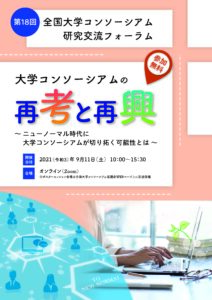
このたび、全国大学コンソーシアム協議会、大学コンソーシアム大阪、大学コンソーシアム京都は共催で「第18回全国大学コンソーシアム研究交流フォーラム」を下記のとおり開催する運びとなりました。
今年度は初のオンライン開催となります。

≪概要≫
1. フォーラム名:「第18回全国大学コンソーシアム研究交流フォーラム」
2. メインテーマ:「大学コンソーシアムの再考と再興~ニューノーマル時代に
         大学コンソーシアムが切り拓く可能性とは~」
3. 開催方法:オンライン(Zoom)
4. 日  時:2021年9月11日(土)10:00~15:30
5. 参 加 費:無料(報告集を希望される方は別途1,000円要)
6. 参加対象:大学教職員、学生、企業関係者、行政関係者、その他一般
7. 企画概要:
■基調講演 
「マネジメント改革による大学運営の再考と再興」
大石 利光氏(学校法人大阪電気通信大学 理事長・学長)
■シンポジウム
「 産・官・学におけるそれぞれの連携取組の現状と今後求められること」
[シンポジスト]   
大石 利光氏(上掲のとおり)
矢田 昌己氏(大阪府政策企画部企画室推進課 課長)
東 潤一 氏(大阪商工会議所 産業部 
        ライフサイエンス・スポーツ産業振興担当課長)
[コーディネーター]
久 隆浩 氏(近畿大学 総合社会学部 教授)
■ポスターセッション
 全国のコンソーシアム組織の取組状況を紹介
■分科会(計4分科会)
・第1分科会(特定非営利活動法人 南大阪地域大学コンソーシアム)
 「大学コンソーシアムにおけるFD・SD事業の検証と今後に向けて
  ~大学改革の中で今後求められるFD・SDを考える~」
・第2分科会(公益財団法人 大学コンソーシアム京都)
 「大学コンソーシアム発のインターンシップ~京都の事例から~」
・第3分科会( 特定非営利活動法人 大学コンソーシアム大阪 )
 「10年後の姿から見るキャリア教育の在り方
  ~コロナ禍の新しい教育実践を未来に繋げる~」
・第4分科会(全国大学コンソーシアム協議会 運営委員会)
 「大学コンソーシアムの活動・組織の再考
  ~ニューノーマル時代の大学・地域の発展のための
 より良い連携の在り方と組織のかたちを考える~ 第3弾」
8. 申込期間:6月16日(水)10:00 ~7月31日(土)
 ※下記URLからお申し込みください。
  https://event.consortium.or.jp/entry/zenkoku18/

 ※本フォーラムの詳細は下記URLからご覧ください。
  https://www.consortium.or.jp/project/zenkoku-conso/forum
                          

 【お問合せ先】全国大学コンソーシアム協議会 事務局
  〒600-8216 京都市下京区西洞院通塩小路下る
        キャンパスプラザ京都内
  ※窓口受付時間:火~土曜9:00~17:00(年末年始を除く)
   電話 : 075-353-9100 FAX : 075-353-9101
   E-mail : alljapan-consortium@consortium.or.jp 

7月31日開催【PDP】「2021年度SDPシリーズ(第1回) 大学等の連携・統合」のご案内(東北大学)

【情報提供:東北大学 大学教育支援センター】

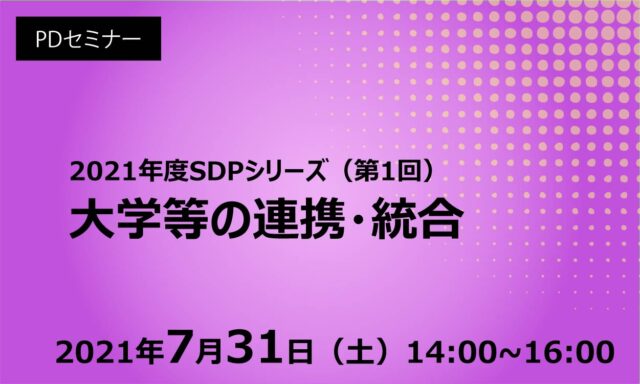
2021年7月31日(土)に下記の通りZoomによるウェビナー【PDP】「2021年度SDPシリーズ(第1回) 大学等の連携・統合」を開催いたします。皆様のご参加をお待ちしております。

**********************************
【PDP】「2021年度SDPシリーズ(第1回) 大学等の連携・統合」
 教育関係共同利用拠点提供プログラム  組織運営論 M-01、高等教育論 L-01
【日時】2021年 7月31日(土)14:00-16:00
【講師】羽田 貴史(広島大学・東北大学 名誉教授)
**********************************

【趣旨】
資源減少時代の大学生き残り方策として、大学の統合・連携に注目が集まっています。中教審答申「2040年に向けた高等教育のグランドデザイン」(2018年)は、「大学等の連携・統合の促進」を掲げ、国立大学の一法人複数大学制の導入、私立大学の連携・統合の円滑化に向けた方策、国公私立の枠組みを超えた連携の仕組みを掲げ、促進のために、従来の共同教育課程に加え、連携開設科目制度(2021年)や地域連携プラットフォームのガイドライン(2020年)、大学等連携推進法人の認定規程(2021年)などの整備を進めています。大学連携・統合は、日本はもちろん諸外国でも古い歴史があり、失敗もあれば成功もあります。国際動向や日本の歴史から何を学び、現在、始まっている連携には何が必要なのか、大学等の連携や統合を大学の置かれた環境を視野においてどのように位置づけたらよいでしょうか。本セミナーでは、東北大学・広島大学名誉教授である羽田貴史氏をお招きして、政策動向や地域性を視野に総合的に検討し、議論で深めたいと思います。大学関係者はもちろん、多くの方々のご参加をお待ちしています。

【プログラム】
14:00~14:05 開会挨拶
戸村 理(東北大学 高度教養教育・学生支援機構 准教授)

14:05~15:15 講演「大学等の連携・統合」
羽田 貴史(広島大学・東北大学 名誉教授)

15:15~15:55 質疑応答

15:55~16:00 閉会挨拶
戸村 理

【参加申込み締切】2021年7月28日(水)

【参加費】無料

【定員】なし

本セミナーはZOOMによるウェビナーです。

【詳細・申込み】
https://www.ihe.tohoku.ac.jp/CPD/events/pd210731/

【お問合せ先】
東北大学 高度教養教育・学生支援機構
大学教育支援センター
TEL: 022-795-4471
Email: iehe-seminar@ihe.tohoku.ac.jp

7月1日開催 「ブレンディッドラーニング事例セミナー~オンライン授業でのアバター活用とバーチャルキャンパス~」のご案内(デジタルハリウッド株式会社)

【情報提供:デジタルハリウッド 細野康男氏】

このたび、2021年7月1日(木)に、「アバターのオンライン授業活用」「バーチャルキャンパス」に焦点を当てたセミナーを開催します。

中央教育審議会「2040年に向けた高等教育のグランドデザイン(答申)」や産業界による「Society 5.0に向けた大学教育と採用に関する考え方」でも取り上げられている通り、新たな時代に対応するための教育改革推進が求められています。
こうした中、コロナ禍の影響下で急速に進んだオンライン授業の実践は、まさにSociety 5.0に向けた新たな教育の取り組みであり、中央教育審議会「教学マネジメント指針」内容からも、今後、学生の学習成果を最大化する教学マネジメントの充実・推進が、わが国の高等教育機関において必要不可欠になってきています。

そこで、今回は学習成果を最大化するための手法の一つである「ブレンディッドラーニング」事例をご紹介致します。
「ブレンディッドラーニング」を構成する要素は多くある中で、特に「メディア(oVice, NICECAMERA, Mozilla Hubs等)」「提供手段(アバター&バーチャルキャンパスによる、オンライン同期型かつ双方向型)」の観点で特徴的な事例です。
アバター活用は、自由自在に「見た目」を選択できる学習環境により、個別最適化されたコミュニケーションの実証実験を、バーチャルキャンパスは、仮想空間で「いつでもどこからでも気軽に集まれる」「大人数でも少人数でもコミュニケーションがとりやすい」等の特徴を活かして学びのコミュニティづくりの検証を行いました。

(キーワード)
個別最適化、アバター、オンライン授業、ブレンディッドラーニング、コミュニケーション、バーチャルキャンパス、コミュニティ

———————————————————————————————————————————–
■セミナー概要
・概要
(1)事例解説(アバターを活用したオンライン授業、バーチャルキャンパス)
(2)事例実演(実際に実演することで、参加者の皆様に疑似体験して頂きます)
(3)今後の課題
(4)質疑応答

・講師
小林英恵 氏
EdTech研究・実践家
探究型キッズプログラミング教室 アルスクール中野校長
オンライン学校 ワンラインスクール代表

早稲田大学教育学部卒業後、株式会社髙島屋に入社。
その後、通信制大学で教員免許を取り、公立小学校教諭に転職。
学級担任として、「子ども会議」「自主計画宿題」「子どもがつける成績評価」など、子ども主体の学級経営を実践。
2020年独立し、現在、デジタルハリウッド大学大学院でEdTechを研究しながら、オンライン学習環境デザイナー・プロデューサーとして活動、自治体、私立学校、NPO法人など、様々な教育機関のプロジェクトに携わっている。
また、IT系ベンチャー企業でECサイト構築CS、子ども向けゲームアプリ開発など、多動力を活かしたパラレルキャリア、プロジェクトベースドワーキングを実践中。

※経歴詳細 https://hanae.style/

・日時:2021年7月1日(木)18:00-19:00 (開場17:30~)

・会場:Zoomを使用したオンラインセミナー(お申込み後にZoomのURLとパスワードをご案内します)

・参加:無料

・対象者:高等教育機関の教学マネジメントご担当者、その他ご関心をお持ちの方

・定員:300名(要予約、先着順)

・申込方法:以下のURLよりお申込み下さい
https://academy.dhw.co.jp/seminar/seminar20210701/

記事のお問い合わせ先
━━━━━━━━━━━━━━━━━━━━━━━━━━━━━━━
デジタルハリウッド株式会社  https://academy.dhw.co.jp/
まなびメディア事業部
細野 康男(Hosono Yasuo)  e-mail : hosonoyasuo@dhw.co.jp
…………………………………………………………………………………
〒101-0062
東京都千代田区神田駿河台4-6御茶ノ水ソラシティ アカデミア3F/4F
TEL:03-5289-9267  FAX:03-5289-9239
TEL(直通):03-3525-4915
━━━━━━━━━━━━━━━━━━━━━━━━━━━━━━━

RIHE Open Seminar “The Publicness of Universities : Analysis of the Discourse and Efficiency” July 19, 2021

The open seminar will be held as follows:

■Date
14:00-15:15, Monday, July 19th, 2021 (JST)

■Theme
The Publicness of Universities : Analysis of the Discourse and Efficiency

■Venue
Online (Zoom) ※We will inform you of the participation URL by the day before

■Language
English

■Lecturer
Jin-Kwon LEE (Seoul National University)

■Abstract
This study focused on the scope of publicness that has not been sufficiently discussed in the field of higher education despite its importance. The main purpose of the study was to examine how the discourse surrounding university publicness is organized, which factors have been discussed as public values, and finally, how publicness affects university performance and efficiency through empirical analysis. Based on the integrated publicness theory, the study derived three sectors to publicness in higher education: ownership, regulatory, and normative publicness. By applying a mixed-method approach of qualitative discourse analysis and quantitative studies, the results were as follows. First, throughout the discourse of the National Assembly’s Education Committee, the politicians shared the idea and belief that public intervention by the government can enhance the effects liken to be driven by publicness of university – although they have not reached a conclusion to which publicness they are referring to. Second, based on the three branches of publicness, it was found that particular types of publicness could lead to positive results on their performance and efficiency. In particular, public universities (which represent ownership by the government, which leads to active governmental support) did not show higher performance compared to private schools. On top of that, regulatory publicness rather seemed to reduce their performance and efficiency – exclaiming that prevailing regulatory actions by the government are rather obstructions to raising their acknowledgment. On the other hand, normative publicness, which was represented by the values shared and realized collectively among organizational members, improved their performance and efficiency.

This implied that the government’s regulatory action against universities, which does not guarantees better performance and efficiency, should be revised. That includes governmental actions of suspending national funds based on evaluation and competition. The government’s funding policy should be conducted in a way that fully guarantees universities their autonomy. Second, with different comprehension available on the publicness of universities, the Government should clarify which publicness they are seeking through their policy. The purpose of “strengthening the publicness through the expansion of public support by the government” should be specified to enhancing the public values shared and expected in higher education. Third, it is necessary to “measure” and “evaluate” the normativity of universities at the government’s policy level so that policies can be formed and implemented in a way that maximizes the normativity of universities as well as the performance of universities.

■Program
14:00 – 14:05 Introduction  Yangson Kim (Hiroshima University)
14:05 – 14:45 Presentation  Jin-Kwon Lee (Seoul National University)
14:45 – 15:15 Discussion (Q&A)

■Note
・If you would like to attend online, an internet access, device with camera and microphone are needed.
・Using your full name for your personal meeting ID is required when you enter the meeting room. You may not receive a permission to enter the room if the ID is different from the name registered.
・As a participant, you are not allowed to record the seminar or take the screenshot at your own.
・Organizing seminar through Zoom is a new attempt for us. Please accept our apologies for any inconvenience this may cause you, and thank you for your understanding.
・We will inform you of the participation URL by the day before. Please contact us at the following address if you do not receive the email.
k-kokyo(at)office.hiroshima-u.ac.jp
*Replace (at) with @

[trust-form id=30555]

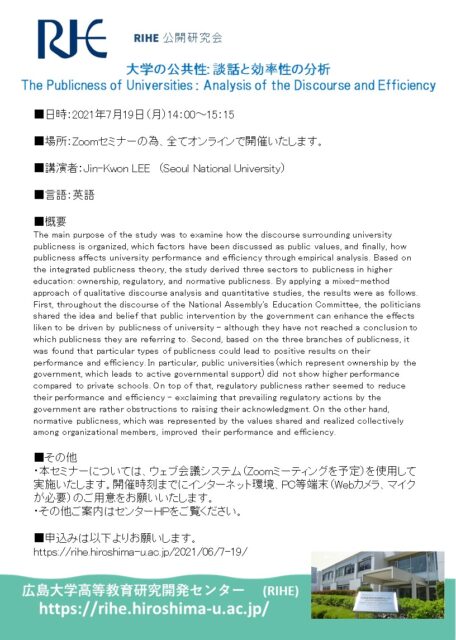
7月19日(月)開催 2021年度公開研究会(オンライン開催)『大学の公共性: 談話と効率性の分析』

クリックすると大きくなります

下記の通り、公開研究会をオンラインにて開催しますので、ご案内いたします。

■日時:2021年7月19日(月)14:00~15:15

■場所:Zoomセミナーの為、全てオンラインで開催いたします。
※お申込みされた方に参加用URLを前日までにご連絡いたします

■テーマ:大学の公共性: 談話と効率性の分析

■講演者:Jin-Kwon LEE (Seoul National University)

■言語:英語

■概要
This study focused on the scope of publicness that has not been sufficiently discussed in the field of higher education despite its importance. The main purpose of the study was to examine how the discourse surrounding university publicness is organized, which factors have been discussed as public values, and finally, how publicness affects university performance and efficiency through empirical analysis. Based on the integrated publicness theory, the study derived three sectors to publicness in higher education: ownership, regulatory, and normative publicness. By applying a mixed-method approach of qualitative discourse analysis and quantitative studies, the results were as follows. First, throughout the discourse of the National Assembly’s Education Committee, the politicians shared the idea and belief that public intervention by the government can enhance the effects liken to be driven by publicness of university – although they have not reached a conclusion to which publicness they are referring to. Second, based on the three branches of publicness, it was found that particular types of publicness could lead to positive results on their performance and efficiency. In particular, public universities (which represent ownership by the government, which leads to active governmental support) did not show higher performance compared to private schools. On top of that, regulatory publicness rather seemed to reduce their performance and efficiency – exclaiming that prevailing regulatory actions by the government are rather obstructions to raising their acknowledgment. On the other hand, normative publicness, which was represented by the values shared and realized collectively among organizational members, improved their performance and efficiency.

This implied that the government’s regulatory action against universities, which does not guarantees better performance and efficiency, should be revised. That includes governmental actions of suspending national funds based on evaluation and competition. The government’s funding policy should be conducted in a way that fully guarantees universities their autonomy. Second, with different comprehension available on the publicness of universities, the Government should clarify which publicness they are seeking through their policy. The purpose of “strengthening the publicness through the expansion of public support by the government” should be specified to enhancing the public values shared and expected in higher education. Third, it is necessary to “measure” and “evaluate” the normativity of universities at the government’s policy level so that policies can be formed and implemented in a way that maximizes the normativity of universities as well as the performance of universities.

■プログラム
14:00 – 14:05 Introduction  Yangson Kim (Hiroshima University)
14:05 – 14:45 Presentation  Jin-Kwon Lee (Seoul National University)
14:45 – 15:15 Discussion (Q&A)

■その他
・参加費は無料です。
・本セミナーについては、ウェブ会議システム(Zoomミーティングを予定)を使用して実施いたします。開催時刻までにインターネット環境、PC等端末(Webカメラ、マイクが必要)のご用意をお願いいたします。
・Zoomにログインする時には、IDに姓名(アルファベット表記)を使用してください。参加申し込み登録者のお名前と違う場合、入室を許可されない場合がございます。
・各自のPC機能等による講演・資料の保存は許可されておりませんのでご留意ください。
・前日までに参加方法のメールが届かない場合は、下記アドレスまでお問合せください。
高等教育研究開発センター <k-kokyo(at)office.hiroshima-u.ac.jp>
(at)を@に置き換えてください。

[trust-form id=30554]

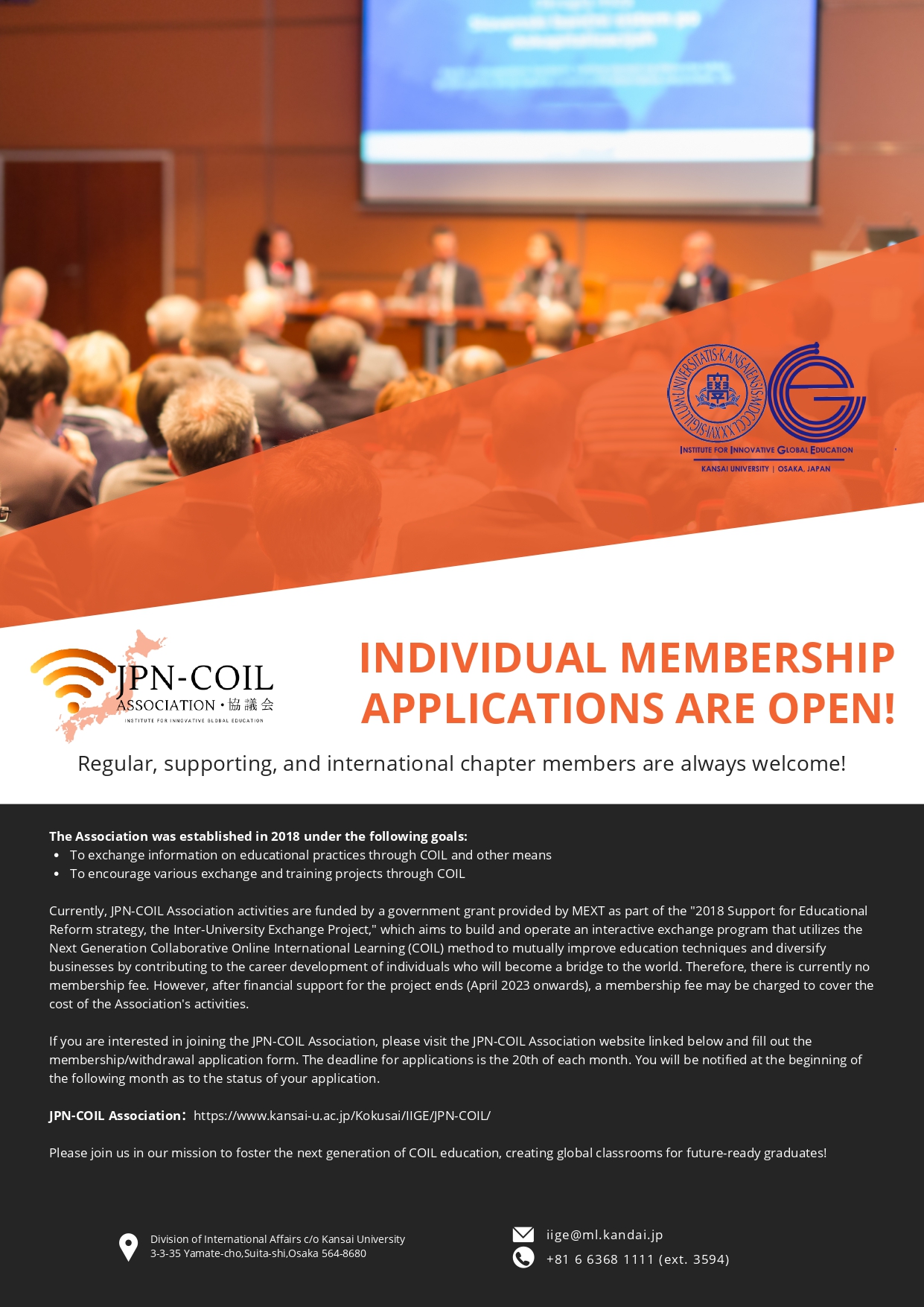
JPN-COIL Association Individual Membership recruitment has started!

Click to enlarge

Warm greetings from Kansai University Institute for Innovative Global Education(IIGE).

We are pleased to announce that we are now accepting applications for individual membership to the JPN-COIL Association.

The Association was established in 2018 under the following goals:
①To exchange information on educational practices through COIL and other means
②To encourage various exchange and training projects through COIL

Currently, JPN-COIL Association activities are funded by a government grant
provided by MEXT as part of the “2018 Support for Educational Reform strategy,
the Inter-University Exchange Project,” which aims to build and operate an
interactive exchange program that utilizes the Next Generation Collaborative
Online International Learning (COIL) method to mutually improve education
techniques and diversify businesses by contributing to the career development
of individuals who will become a bridge to the world. Therefore, there is
currently no membership fee. However, after financial support for the project
ends (April 2023 onwards), a membership fee may be charged to cover the cost
of the Association’s activities.

In addition to this open call for individual membership applications, we are
also still accepting applications for regular, supporting, and international
chapter membership!

If you are interested in joining the JPN-COIL Association, please visit the
JPN-COIL Association website linked below and fill out the membership/withdrawal
application form. The deadline for applications is the 20th of each month.

You will be notified at the beginning of the following month as to the status
of your application.

JPN-COIL Association’s website page:https://www.kansai-u.ac.jp/Kokusai/IIGE/JPN-COIL/

As of June 9, 2021, we have 37 regular members, 7 supporting members, 9
individual members, and 5 international chapter members. Please see here(https://www.kansai-u.ac.jp/Kokusai/IIGE/JPN-COIL/#memberlist) for more details.

The following are some of the benefits of membership.
For more information, please visit the Association’s website page.

【General Assembly Participation】
Currently held online annually/biannually.
We make resolutions regarding the operation of this Association, share COIL reports from each regular member university, and exchange opinions.
Only regular members have voting rights, while other members are allowed to observe the meetings.

【Member-Only Events/Program Participation】
Association members will be given priority to receive information on various seminars, workshops, and online international education programs for students, aimed at educators who currently or are planning to implement COIL. Some seminars and workshops are offered only to Association member institutions.

【Overseas University Matching】
*Regular Members and International Chapter Members Only

【Individual COIL Consultation/Guest Speaker Request】
*Regular Members and International Chapter Members Only
Please join us in our mission to foster the next generation of COIL education, creating global classrooms for future-ready graduates!

Frequently Asked Questions: https://www.kansai-u.ac.jp/Kokusai/IIGE/contact/

Please do not hesitate to contact us (iige@ml.kandai.jp) with any further questions.