
Associate Professor Sakurai’s co-authored paper is published.
For details, please visit here.
Title: Proactive strategies for doctoral students to enhance their well-being: A systematic literature review
Authors: Sakurai, Y., Cheng, W., Saruta, S., Zheng, R., Mason, S., Singh, J. N., Li, H., Dai, M., Qin, H., & Elliot, D. L.
Book Title: The Routledge international handbook of learning and instruction in university education
URL:https://doi.org/10.4324/9781003540496-33
outline:
This study was conducted by a research team led by Associate Professor Yusuke Sakurai, Hiroshima University. The team included Wenjuan Cheng and Shizuki Saruta, current doctoral students, and Ruonan Zheng, a doctoral graduate of the university, along with researchers from Nagasaki University, La Trobe University in Australia, Xi’an Jiaotong-Liverpool University in China, The University of Hong Kong, and the University of Glasgow in the UK. The team conducted a systematic review of empirical research on doctoral students’ well-being.
Doctoral study often involves uncertainty, isolation, high expectations, and prolonged academic work, all of which can affect students’ mental and physical health. Based on 59 empirical studies published between 2014 and 2024, this article introduces four “Rs” that can help doctoral students proactively maintain and improve their well-being.

The first is Reflect: examining one’s motivations, emotions, expectations, progress, and challenges. This includes viewing progress not only in terms of research outcomes but also mental well-being. Journaling and developing realistic, positive self-understanding can be useful practices.
The second is Routinise: developing sustainable work and life rhythms. Manageable work habits, planning, rest, sleep, exercise, and time away from research can support well-being over the long term. The goal is not constant work, but a rhythm that enables continued research while allowing physical and mental recovery.
The third is Reveal: sharing anxiety, difficulties, concerns about progress, or supervisory challenges with supervisors, peers, family, or counsellors. Communicating these concerns can help students access support, recognise that others have similar experiences, and reduce isolation.
The fourth is Relate: building connections with peers, writing groups, academic communities, friends, and family. Although doctoral work can be highly individual, these relationships foster belonging, mutual support, and resilience.
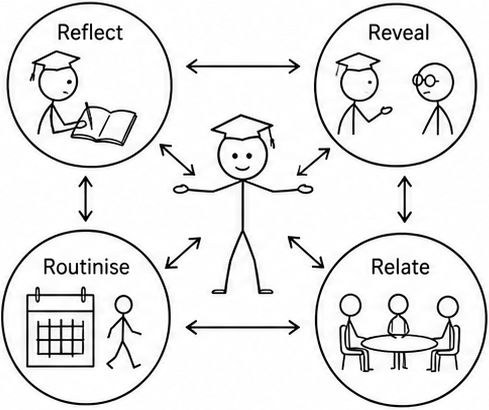
The four Rs do not mean that students should manage everything alone. The review also highlights the need for supportive supervisory relationships, accessible support services, and university cultures that respect rest and help-seeking. The article offers practical ideas for students, supervisors, and university staff to work together in supporting well-being in doctoral education.