
Associate Professor Sakurai’s co-authored article is published.
Title: How researchers across career stages experience researcher independence: A visual collaborative autoethnography
Authors: Yusuke Sakurai, Jin Yu, Dangeni, Anding Shi, Wenjuan Cheng, and Kelsey Inouye
Journal: Innovations in Education and Teaching International
URL: https://doi.org/10.1080/14703297.2026.2666368
Overview of the Study
The development of researcher independence is not a fixed goal but a bumpy journey. It involves trial and error, deliberate choices, encouragement from others, and the realities of unstable academic employment, all of which interact in complex ways.
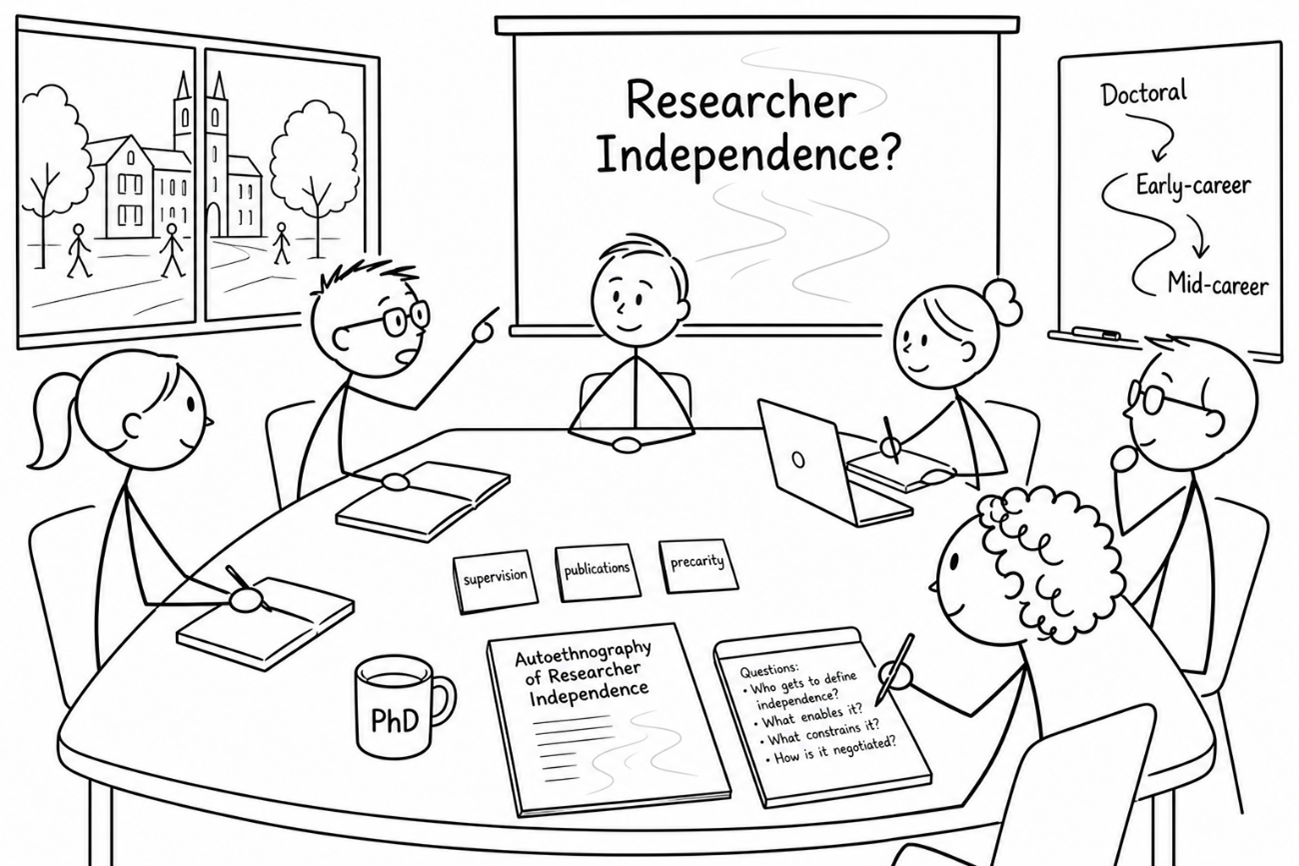
Image: Generated by Perplexity
In this study, six education researchers at different career stages (Yusuke Sakurai: Hiroshima University; Jin Yu: The University of Glasgow; Dangeni: Anglia Ruskin University; Anding Shi: The University of Oxford; Wenjuan Cheng: Osaka University (doctoral candidate at Hiroshima University); Kelsey Inouye: The University of Oxford) reflected on their own pathways as researchers. We used a visual method known as the “river of experience,” in which each participant represented their journey as a river. Bends and branching points in the river indicated events that shaped their sense of independence. Using these drawings as prompts, we conducted group discussions and carried out a collaborative analysis.
The analysis revealed three key messages. First, researcher independence is not a stable state but a dynamic and uneven process. Participants described moving between confidence and uncertainty, and between dependence and independence, as they responded to feedback, presented at conferences, published papers, and adapted to new roles. Second, researcher independence is an active process. In simple terms, it does not develop naturally over time; rather, it is built through making choices, experimenting, taking opportunities, and developing judgement. Third, researcher independence is supported by recognition. This includes internal dimensions such as self-understanding and self-acceptance, as well as external factors such as feedback from supervisors and peers, paper acceptances, research funding, and employment opportunities.
An important insight from this study is that researcher independence does not mean isolation. In many cases, researchers become more autonomous through being challenged, supported, and recognised within relationships with others. Another key contribution of this study is that researcher independence continues to develop beyond the doctoral stage. It is shaped not only by ideas and abilities but also by structural factors such as unstable employment and the roles and opportunities available to postdoctoral researchers.