
Associate Professor Yusuke Sakurai’s co-authored paper is published on Journal for New Generation Sciences.
For details, please visit here.
Title: “Conceptualising Intellectual Humility in Advanced Research Contexts: Insights for Postgraduate Supervision”
Authors: Ruth M. Albertyn, D. L. Elliot, and Y. Sakurai
Journal: Journal for New Generation Sciences
Summary: Intellectual humility in postgraduate supervision
This paper is a conceptual paper that clarifies the idea of “intellectual humility” in the context of postgraduate research supervision. It is written primarily for supervisors, practitioners, and researchers with interests in doctoral education and researcher development.
Postgraduate research is often described as a creative journey of producing new knowledge. However, it can also involve uncertainty, power imbalances, and demanding supervisory experiences that may place significant pressure on students. The paper argues that such negative experiences can seriously undermine both the process and outcomes of degree completion, and it proposes a new framework for supervisory relationships by focusing explicitly on intellectual humility as a virtue. A central concern is how to support the research process, including relational and emotional dimensions that are often overlooked in supervision focused mainly on outputs and information.
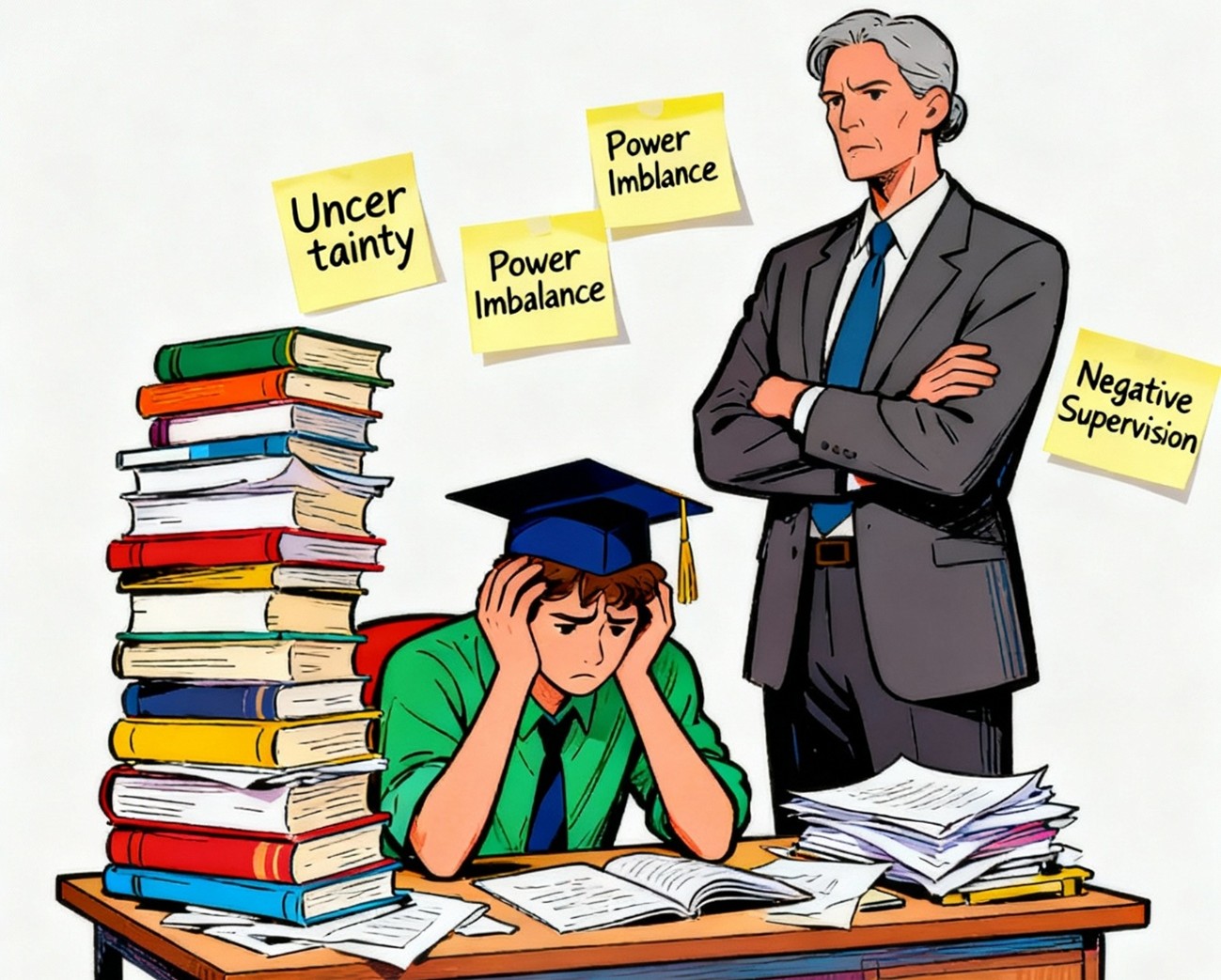
An image generated with AI by Perplexity
Drawing on the “doctoral intelligence” framework, the authors outline four mindsets required for researchers: Knowing (disciplinary knowledge), Doing (actions to follow through and complete work), Thinking (higher-order thinking), and Willing (an open, ongoing learning orientation). They suggest that postgraduate education has tended to emphasise Knowing and Doing, while Thinking and Willing have often remained implicit within the “hidden curriculum”, such as supervisory conversations and laboratory or departmental culture. The paper, foregrounding the Thinking and Willing dimensions, reframes intellectual humility as an orientation that realistically recognises one’s strengths and limitations and remains open to others’ perspectives while living with uncertainty.
Building on prior research in philosophy and psychology, the paper positions intellectual humility as a balance between arrogance (overestimating oneself) and excessive self-deprecation or submissiveness (underestimating oneself). It also offers practical guidance for cultivating intellectual humility in supervision, including treating uncertainty as normal, using Socratic questioning to help students articulate their thinking, supervisors modelling openness by verbalising their own limits and uncertainties, and creating collaborative learning spaces that enable safe dialogue and the testing of ideas. Through these approaches, the paper emphasises shifting towards a supervisory relationship in which students and supervisors “wonder together, think together, and grow together” as the goal of postgraduate education grounded in intellectual humility.
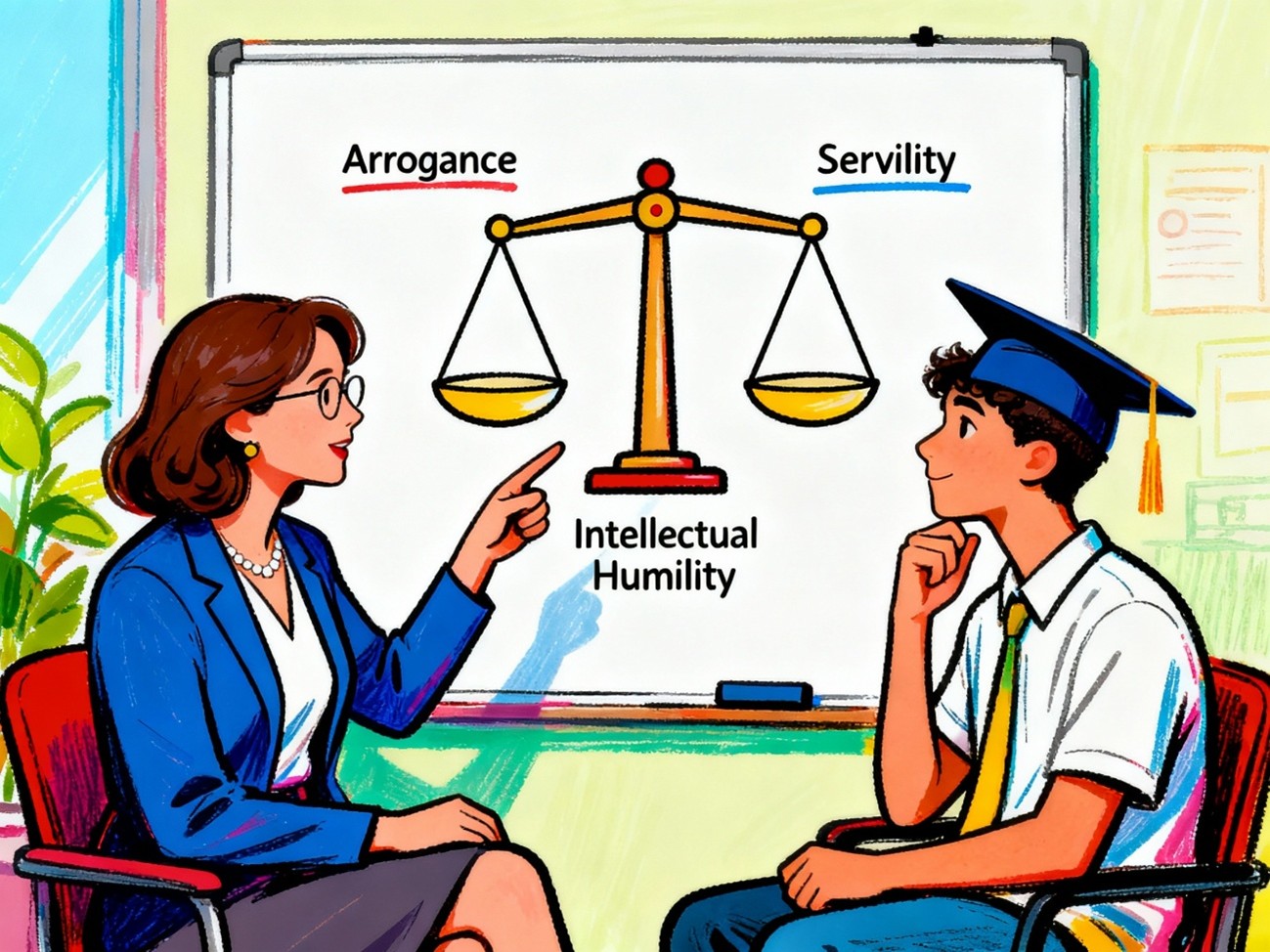
An image generated with AI by Perplexity